
Most social media companies claim they require their sites’ users to be at least 13 years old. But no surprise, younger kids use the sites, too. In fact, a majority of preteens say they do — and some have problems as a result. That’s the finding of emerging data from a new study.
Courtney Blackwell works at Northwestern University’s Feinberg School of Medicine in Chicago, Ill. Her work focuses on how kids’ social world affects their mental well-being. One of her team’s projects looks at social media use among 8- to 12-year-olds. Its data come from an ongoing National Institutes of Health program called ECHO. That’s short for Environmental Influences on Child Health Outcomes. This project regularly surveys thousands of U.S. children.
More than two-thirds of the 4,700 preteens it’s been surveying report using social media, Blackwell’s team finds. That’s almost twice as many as reported doing so five years earlier.
On average, preteens spent 1.57 hours per day on social media. However, Blackwell points out, “there’s lots of variability.” Some kids were on these sites more than four hours per day.
YouTube was the most popular social media site for the roughly 3,100 preteens who said they used social media. More than eight in every 10 of them reported being on it. Almost one in every four had used TikTok and Facebook.
Preteens gave entertainment and fun as their top reason for using social media. More than half said they turn to it to learn new things or connect with friends and family. “There are some really positive ways they’re using it,” Blackwell says. “So it’s not just this negative platform.”
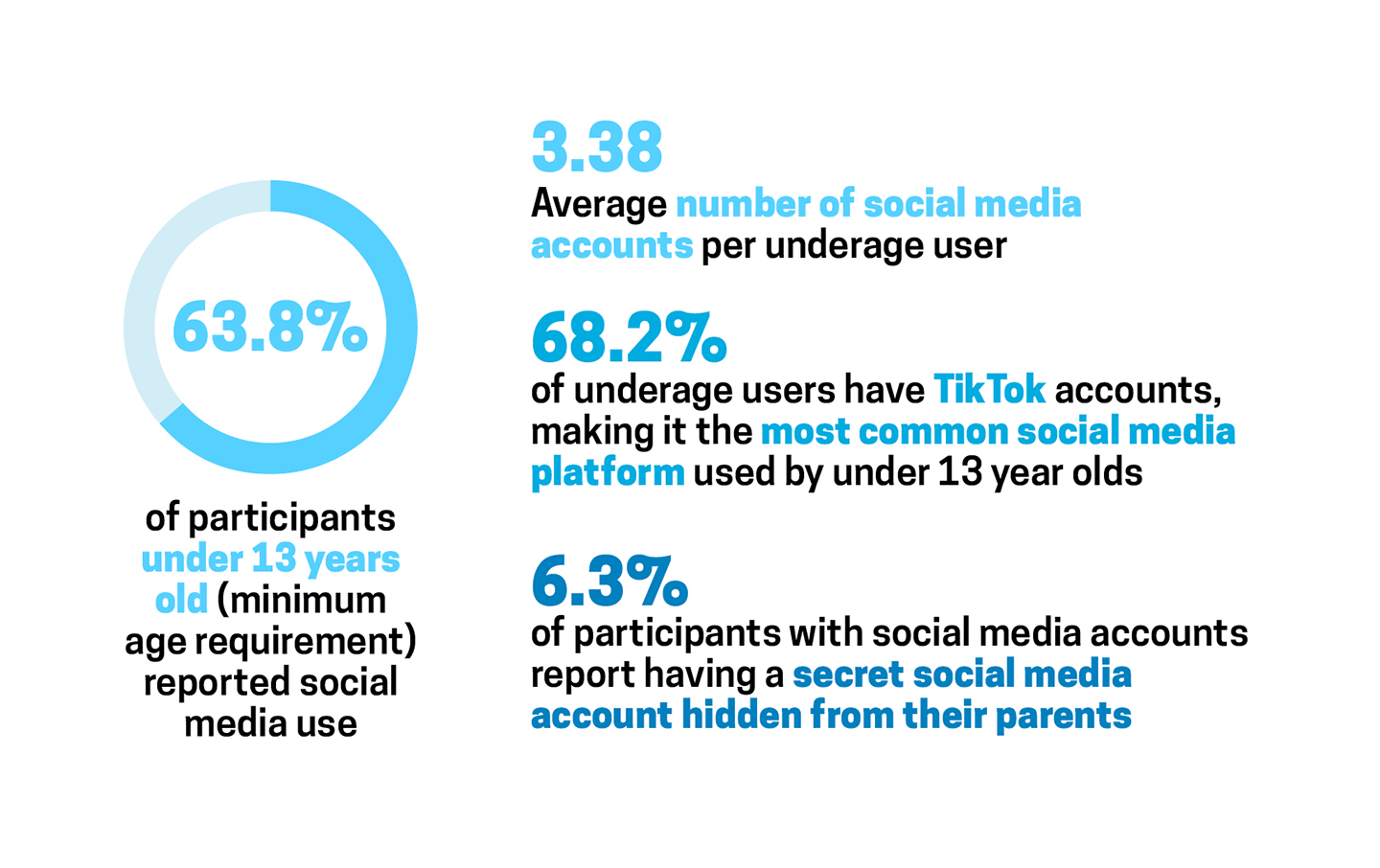
Roughly one-third use social media for things such as calming down when stressed, forgetting about problems or avoiding things they need to do.
There is one clear downside to some social-media use. About one in 10 underage kids reported having been cyberbullied on it, Blackwell’s group notes.
A 2022 analysis by different researchers found a similar share of 11-and 12-year olds had been targets of cyberbullying.
“Being bullied in general can lead to poor mental health,” says that study’s lead author, Jason Nagata. He’s a doctor who specializes in teen health at the University of California, San Francisco. Online bullying, he adds, also may be harder to stop than the face-to-face type. People can bully others from far away or even anonymously. Those data came from an ongoing study known as ABCD (for Adolescent Brain Cognitive Development).
Too much of a (sometimes) good thing?
Blackwell’s team wondered whether and how social media use might sometimes be unhealthy. To gauge that, they looked at answers to nine questions. For example: Did kids try — unsuccessfully — to spend less time on social media? Did they regularly lie about how much time they spent on it? And did they use social media to escape negative feelings?
Roughly 9 percent of the social media users said yes to more than half of the questions. “I was not expecting that many kids,” Blackwell says, at least not at so young an age.
Kids with certain mental-health issues — such as anxiety or depression — or ADHD were more likely to fall into that group. In contrast, kids who didn’t start using social media until they were teens were less likely to have said “yes” to so many questions.
Blackwell’s team shared its findings during a webinar on February 11. The scientists plan to publish those data in the coming months.
Use social media carefully
Many studies have explored screen use by very young children or by teens. Fewer have looked at this “middle group” of 8- to 12-year-olds, notes Kate Blocker. She’s a child-development specialist in Huntsville, Ala. There she heads up research for Children and Screens, a New York City-based nonprofit.
“While social media can be a place for entertainment and connection, over one-third of kids are also using it as a ‘digital escape’ to avoid tasks or to forget about personal problems,” she observes. That suggests some kids may be harmed on platforms meant for adults.
“We need more research, better designs and stronger safeguards to support children’s well-being online and offline,” she concludes.
Do you have a science question? We can help!
Submit your question here, and we might answer it an upcoming issue of Science News Explores
“Screens and social media aren’t inherently bad or good,” Nagata adds. So, he suggests, think about how social media makes you feel. Try to maximize the good aspects and minimize the bad. If you think social media is interfering with other things in your life, set limits. And maybe seek help from parents, teachers or a trusted adult.
Another tip from Nagata: Have a purpose when you go online. Once you finish that, sign off. Plan activities beyond social media, too. You’re less likely to feel bad about “missing out” online if you’re playing sports or doing other fun things with friends, he notes.