Floral designs on pottery made almost 8,000 years ago may be more than just art. They appear to be the earliest evidence of math-based thinking.
The designs appear on pottery made by ancient Halafians. These people lived in Mesopotamia between about 6200 B.C. and 5500 B.C. (Mesopotamia was an ancient region in what is now Iraq. Some of the world’s first civilizations arose there.)
The Halafians were known for their skilled ceramics. Many of the floral designs on their pottery show regular numbers of petals. Those patterns hint that these people used math in their art, archaeologists now say. The researchers shared these findings in the December 2025 Journal of World Prehistory.
Archaeologists knew that Mesopotamia’s Sumerian people used math. Sumerians are famous for creating the first writing system around 3000 B.C. They did math based on the number 60. That’s the same type of system that gives us 60 seconds per minute and 60 minutes per hour.
The new findings suggest Halafians used math thousands of years before the Sumerians. If so, these ancient people may have also used their math skills to divvy up land and crops.
Counting petals
The Halafians lived in the latter part of the Neolithic period, or new stone age. During this time, people settled into villages, made stone tools and began farming. They also practiced crafts, such as weaving and pottery.
Halafian pottery often carried plantlike designs, such as trees, shrubs and flowers. The new study cataloged all these designs. But the flowers are what “give us an indication of mathematical knowledge,” says Yosef Garfinkel. He did the research with Sarah Krulwich. Both work at the Hebrew University of Jerusalem in Israel.
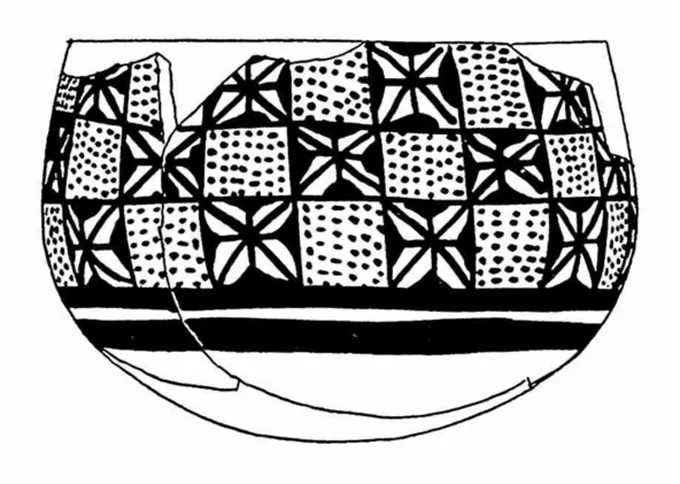
The pair studied thousands of pottery fragments that had been dug up since the 1930s. Among those, 375 had floral designs. In nearly every case, the flowers had four, eight, 16, 32 or 64 petals. All those numbers are powers of two.
These numbers are not accidental, the team says. Rather, they show that Halafians had a deep knowledge of math based on doubling numbers. These people also may have used this math savvy to divide up land and crops.
“This is evidence of [math] knowledge that we are not aware of from any other source,” Garfinkel says.
Large patterns on some fragments also show math skills. Many are from ornately painted bowls. Some are painted with stylized flowers inside checkerboard patterns. The designs show knowledge of symmetry, geometry and division of space.