

Topology (noun, “top-AH-low-jee”)
Topology is a field of math that focuses on how molding or stretching a shape alters the space it takes up.
In a way, topology is similar to geometry. Both fields study shapes. However, geometry focuses on rigid measurements, such as the length of lines in a triangle. It answers questions like: If I change the length of this line, how will the other lines change? In geometry, the new triangle is considered a different triangle altogether.
But topology does not focus on such rigid measurements. Instead, topology treats the study of shapes like a game. As in a game, a topologist sets out certain rules. Then, they explore what shapes are possible within those rules.
For instance, a rule might be that all the shapes in a certain family can morph into one another without tearing or gluing parts together. You could explore this yourself by squeezing a water balloon. As you watch the balloon warp, you see continuous changes to its shape. Squeezing the middle causes the outsides to bulge. But the balloon doesn’t break or form new connections. So, all the shapes the balloon takes still obey the rule.
A mathematician might say that all the shapes of this balloon belong to the same topological group.
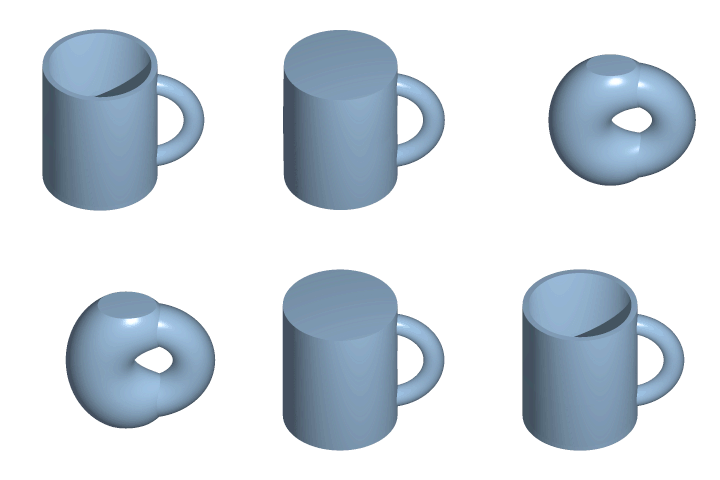
Another rule might be that all the shapes in a group must have one hole. A donut is an obvious member of this group. But so is a mug. If you made both of these shapes out of clay, you could remold one into the other without tearing the clay or attaching any new pieces. Under the one-hole rule, they are in the same topological family.
A particularly mind-twisty rule might be that all shapes in a family have “non-orientable surfaces.” That means the shape doesn’t have a clear outside and inside. A loop with a twist in it, called a Möbius strip, is a famous example.

Topology can be represented in many ways. Computer models can render and play with shapes. The math of algebra can describe concepts in topology, too.
Setting up rules for shapes and playing around with them is more useful than you might think. It helps scientists understand what is physically possible and impossible. Engineers can use these insights to imagine new technologies. Cosmologists use topology to describe the shape of our universe. And physicists who study string theory use it to probe the nature of matter.
In a sentence
A Möbius strip is one famous example of a curiously mind-bending shape from the field of topology.