

PHOENIX, Ariz. — Nervous? One day soon, relief might be just a chew away.
For years, research has been showing that chemicals found in passionflower plants can help fight anxiety. Two teens have now created a chewing gum that can release those chemicals.

“Gum is very popular among high schoolers,” says Zackary Nizker, 16. This junior at McIntosh High School in Peachtree City, Ga., hopes this habit will make gum an easy way for teens to deal with anxiety. And there are many who face this. “In the U.S.,” Zackary says, “a third of all adolescents and young adults suffer from a form of anxiety.”
But teens aren’t the only ones who could use some relief. Zackary’s grandmother struggles with nervousness, which he says “got really severe last year.” The drugs she got prescribed help, he says, though their side effects can be “very severe.” In his grandma’s case, “she could hardly walk or stand. It was a very scary situation.”
Flavonoids are antioxidant chemicals made by many plants. The plants use them to fight tissue damage from oxidation. Many herbal remedies contain these compounds, too, notes Sara Hoti, Zackary’s classmate. Chamomile, used in some teas, is one flavonoid-loaded herb. But for their study, she and Zackary used an extract of a plant that grows wild in their hometown: passionflower (Passiflora incarnata).
Their work earned these teens a spot as finalists here at the 2026 Regeneron International Science & Engineering Fair, or ISEF. It’s a program created and run by Society for Science (which also publishes this magazine). As fourth place winners in the Translational Medical Science division, Sara and Zackary took home $600. They were among 1,725 students — from 65 nations or territories — competing at the 76th annual ISEF. Participants this year shared nearly $7 million in prizes.
Flower-powered relief
“Chewing gum, by itself, is already known to reduce anxiety,” says Zackary. But a host of studies going back decades shows that passionflower flavonoids reduce anxiety. They do this, he explains, by increasing brain levels of a signaling compound known as GABA. (That’s short for gamma-aminobutyric acid.) “It slows down neuron firing in your brain,” Zackary says. That slowdown, he says, seems to calm an anxious brain.
By combining herbal remedies with rhythmic chewing, he says, their new gum could become “a more effective treatment.” But to test whether chewing gum would release any flavonoids in it, they needed to run some tests.
To start, they cooked up some bubble gum. It included a gum base, powdered sugar, various other sweeteners — and, of course, passionflower extract.
Chew on this
The finished chewing gum was molded into a strip, then cut and wrapped in parchment paper and foil. The gum contains all ingredients — including melted gum base, softeners, sweeteners and flavonoids. After drying, sugar was coated on the outside of the gum.
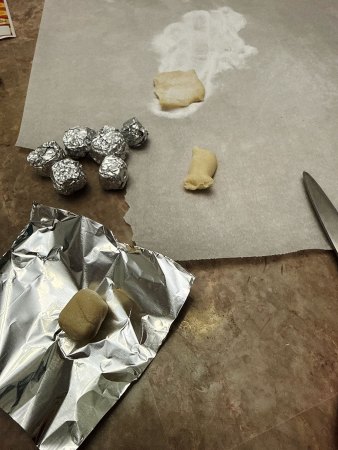
The teens had hoped to make that extract. After all, Sara says, in her hometown, passionflowers are everywhere. But the pair did their experiment during the winter, when the flowers were “all gone — out of season.” So they ended up having to buy the extract.
Afterward, they tested their prototype gum — and struggled, Zackary recalls. Why? “We’re not allowed to just give people some random gum we made and say, ‘Here, chew this, let’s see if it works.’” Instead, they had to do tests “outside of the body.”
Double bubble testing
The pair conducted two tests. The first examined whether each quantity of gum contained the same dose of passionflower extract. So they analyzed slices of the gum under a microscope. Using computer software, they could calculate the share of the flavonoid particles in view. Here, Sara says, “you want your value to be below 15. We actually got a value of 8.4, which was perfect.” (In these tests, Zackary adds, the “values” do not come with a unit.)
A second test, called the Shinoda test, measured how well flavonoids in their gum resist breakdown. If they broke down, the likelihood they’d prove helpful against anxiety could fall apart, too. So the young scientists exposed their gum to various conditions and then used this color-changing test to check whether the flavonoids had held up.
This test is usually done with liquids. Their gum was a solid. So learning how to Shinoda test their gum proved a “really long process,” Sara says.
To mimic the work of saliva, they cut their gum into pieces and soaked them in alcohol for three hours. And nothing happened. The flavonoids never left the gum.
To use the gum you’d chew it, they realized, an action which could release the flavonoids. But “since we couldn’t chew it ourselves,” Zackary says, “we broke the gum into pieces with our hands. That simulates chewing.” They also extended their soak time to three days.
This time, “we got this bright orange coloration change,” says Sara. That showed that the gum’s flavonoids had been released but not broken down — even after exposure to hydrochloric acid and other harsh conditions.
In the future, the teens want to find ways to market their gum and test in people its ability to relieve anxiety.
“Medicated chewing gum is not a new thing,” says Sara. Energy-boosting gums, which release a stimulant, already exist. Smoking-cessation gum contains nicotine. And you can buy passionflower teas. But “nowhere on the market is there a gum for anxiety,” says Sara.
She hopes their recipe could help anyone who feels a bout of nervousness coming on. Maybe you’re “going into an interview or a presentation,” she says. “You can just [chew] this and you know, chill out.”
Do you have a science question? We can help!
Submit your question here, and we might answer it an upcoming issue of Science News Explores