

The kraken — a giant, tentacled sea monster that dragged ships into the depths — is a creature of Norwegian myth. But millions of years ago, a similar, real-life animal roamed the oceans, a new study finds.
The new analysis of jaw fossils suggests that as dinosaurs ruled the land, whale-sized octopuses ruled the seas. These super-sized cephalopods would have been the largest marine animals of the Late Cretaceous Period. That’s from about 66 million to 100 million years ago.
Researchers reported their findings April 23 in Science.
It’s difficult to study fossil octopuses, notes Yasuhiro Iba. He’s a paleontologist at Hokkaido University. That’s in Sapporo, Japan. With soft bodies, these animals tend to break down before becoming fossils. Very few hard parts remain to fossilize. Fortunately, both ancient and modern-day octopuses have a hard, beak-like jaw. This structure is made of chitin (KY-tin). This material is strong enough to survive the animal’s death and fossilize.
The jaws appeared to come from an octopus-like creature. But until now, details of the body size and animal’s role in the ocean ecosystem had been a mystery, Iba says.
A fresh look at old fossils
To find those details, Iba was part of a team that examined 15 fossil jaws. Found in Japan and Canada’s Vancouver Island, they date to near the end of the age of dinosaurs.
Iba’s team took careful measurements. They also compared the mystery jaws to those from other species of octopus and squid. The team also found 12 jaw fossils embedded in rocks in Japan. Some were too fragile to dig out. So they examined them with a technique called digital fossil mining. It records fossils as detailed in 3-D digital images.
To make these images, they ground down the rocks layer by layer. Each layer exposed a new bit of the fossils. The researchers then took photographs of each layer. Afterward, the team used these images — with some help from artificial intelligence — to make digital models of the fossils.
Researchers once thought these 27 cephalopods belonged to five extinct species. But as Iba and his colleagues learned more about them, they divided them into just two. There was Nanaimoteuthis jeletzkyi (Nuh-NY-moh-TOOTH-is Jeh-LETZ-skee-eye) and the much larger N. haggarti. The new analyses suggest the behemoths were early finned octopuses.
This group of deep-sea animals has webbing between their arms and flapping fins on the other end of their body. Finned octopuses still exist. One example is the dumbo octopus. The ancient ones were much, much larger.
Going big
Perhaps the largest invertebrate ever known, the giant dinosaur-era octopus lived more than 72 million years ago. This predator dwarfed even the giant marine reptiles, such as plesiosaurs, not to mention today’s largest invertebrate, the giant squid.
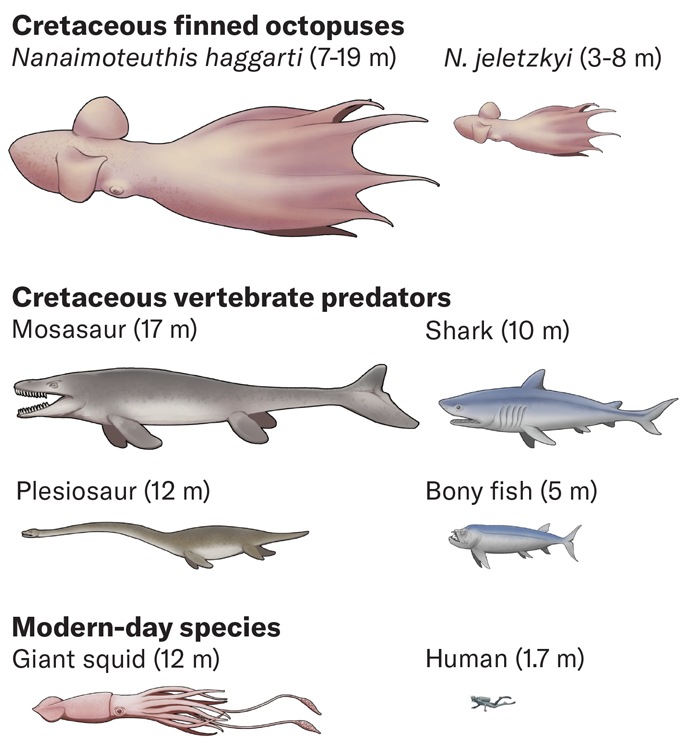
The largest lower jaw from an N. haggarti was big enough to hold a grapefruit. It also was about 50 percent bigger than that of the modern giant squid. At 12 meters (39 feet) long, that squid is one of the largest cephalopods alive today.
Iba estimates that N. haggarti could have spanned seven to 19 meters (23 to 63 feet) from its head to the tips of its arms. That’s between the length of an ambulance and a school bus.
The animal “may have been among the largest invertebrates in Earth’s history,” Iba now concludes.
No bones about it
N. haggarti appears to have been bigger than even the largest ocean predators of its time. These would have included huge reptiles, such as mosasaurs and long-necked plesiosaurs.
Clues in the fossil jaws suggest the ancient giant octopuses competed with those top predators for a spot in the food chain. The researchers found wear and damage to the animals’ jaws. These scrapes and scuffs suggest the octopuses had been powerful predators. Biting on shells and bones likely roughed up their jaws.
That discovery seems to shed new light on ancient marine ecosystems. It suggests that a wider range of predators roamed the ancient seas than once thought.
“For a long time, the top of the marine food web has been thought to be dominated by large vertebrates,” Iba says. By mosasaurs and plesiosaurs, for example. “Our study shows that giant invertebrates — octopuses — also occupied that role in the Cretaceous,” he says.
It’s possible that Nanaimoteuthis was a bit smaller, notes Christian Klug. He’s a paleontologist at the University of Zurich, in Switzerland. The fossil remains are incomplete, he notes. Iba’s team used only the jaw fossils as it estimated total-body length.
Still, he says, “there is no doubt that these animals ranged among the top predators.” Future findings, he adds, may help pinpoint their roles in those ancient seas.
Paleontologist Adiël Klompmaker works at the University of Alabama in Tuscaloosa. He hopes some giant octopus fossils will turn up with well-preserved stomach contents. “That would tell us what they ate,” he says. Were they hunting shelled invertebrates, such as large ammonites? “Or did they also go after large vertebrates?”
Only time and more work by paleontologists will reveal such “kraken” secrets.