

The three-banded armadillo has an unusual way to protect itself. When threatened, it rolls itself up. The adorable mammal’s thick plates form a nearly impenetrable ball that just may save its life. That ability has now inspired the outer shell for a new robot — one that can keep fragile stuff, such as electronics, from getting damaged.
Like an armadillo, the new device changes shape to protect itself with a rigid shell, says study leader Jianyu Zhou. He’s a mechanical engineer at North Carolina State University, in Raleigh.
His team’s new gadget starts out flat. But when touched, it can roll up into a wheel. A hard, 3-D printed outer surface will guard its contents from puncture, breakage or falls.
The design can protect components built into a device. But there’s also “an inner space,” Zhou adds. So it can hold and protect a small payload, too.
His NC State team describes its morphing robot and how it might be used in the May 27 Science Advances.
How to balance rigid and flexible
Zhou works in the lab of Yong Zhu, much of whose work has focused on flexible electronic devices — ones whose electronic innards tend to be fragile. Such gadgets might be wearable fitness trackers or patches that measure blood pressure or blood-sugar levels.
Zhu’s group also has created soft, squishy robots. Inspired by caterpillars, these might wriggle through debris after a natural disaster to help search for survivors or assess damage. They also might be sent out to explore and study hazardous sites, such as the floor of the deep ocean or areas near an active volcano.
Such outings could put soft, morphing robots at risk of getting crushed, fried or pulverized. “The natural question,” Zhu says, has been “how to protect those.”
When he and Zhou set out to explore new defenses for fragile electronics a few years ago, they looked to nature.
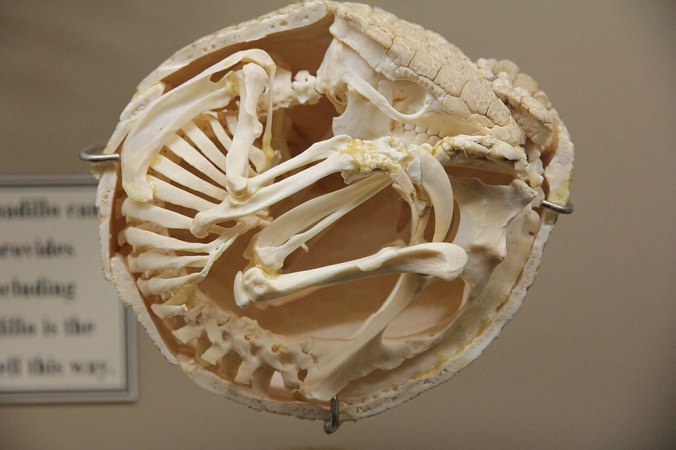
Some animals, such as turtles, have hard shells to keep predators or other dangers at bay. But the armor protecting three-banded armadillos and pangolins has another benefit: It can change shape, allowing the animals to form an almost perfect sphere.
Despite being able to morph, it offers a protective “rigid shell,” Zhou points out.
Anatomy of the robo-armadillo
It took the engineers more than a year to create their new robot. The challenge: They had to find a design that could curl up and lock into itself. For this, they took a layered approach. On the outside is a hard shell made from rigid, protective plates. They not only connect but also bend.
Inside this shell are layers of a flexible material that acts like a synthetic muscle. One layer expands when heated. Under that is a layer that contracts when heated. The innermost layer of the device is an inner skeleton made of almost-triangular pieces that lock together as the device rolls up. Zhou says it comes together like an origami creation.
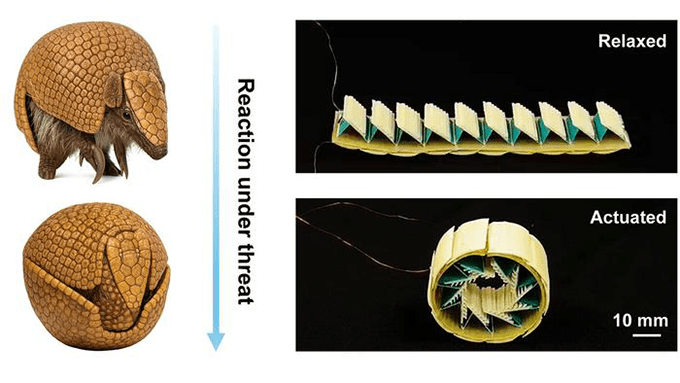
Next, the team had to create a sensor that, when triggered, will set the shell in motion. When it detects a vibration nearby, which could be as gentle as a touch, this sensor sends a signal to an actuator. That component turns on a tiny heater that warms the muscle-like material. That material contracts, pulling everything together to form a wheel-like structure. The entire process takes about a minute.
Nina Attias has been studying armadillos for decades as a conservation biologist in Brazil. She works for the Wildlife Conservation Network, based in San Francisco, Calif. “I am passionate about armadillos, I love them,” she says. She’s happy, but not surprised, that these animals inspired the new robot. “Once you start knowing about them,” she says, “you see that these are pretty amazing creatures.”
The new device impressively mimics the armadillo’s strengths, she says. Only three of the 20 known armadillo species can roll into a ball. Those include the three-banded armadillo native to South America. It’s super-sensitive to vibrations, she adds. It can sense yummy underground termites. These armadillos also can detect the approaching steps of a jaguar that views them as lunch.
After sensing a touch, the new device similarly rolls itself up. And its contracting material, between the shell and skeleton, act like the strong muscles that keep an armadillo’s armor in place. When an armadillo rolls up, “you can’t open it for anything,” Attias says.
The new device survived a range of tests. For instance, the researchers dropped it from a few feet onto a bed of tacks. Fragile objects inside it, including glass spheres and raspberries, remained unharmed.
What’s exciting about the new device, Zhou says, is how it brings rigid and soft parts together. “The armadillo offers a good balance between function and protection,” he says.
Zhu says it’s too soon to know how people might decide to use such a device. But he’s encouraged by the success of a nature-inspired way to solve an engineering problem. In future work, he says that he’ll be looking at other animals for more inspiration.